Every successful project begins with a clear vision and a defined path. Without a detailed understanding of what needs to be accomplished, projects often drift off course, exceed budgets, or fail to meet expectations. This lack of clarity is a common pitfall for organizations across all industries.
A well-crafted scope of work (SOW) document serves as the foundational blueprint, guiding every phase of a project from initiation to closure. It acts as a critical communication tool, ensuring that all stakeholders share a common understanding of project objectives, deliverables, timelines, and responsibilities. Implementing a standardized project manager scope of work template can drastically improve project outcomes and team efficiency.
This article will explore the essential elements of an effective project SOW, detail its key components, and provide a practical sample. By the end, you will understand how to leverage a robust project manager scope of work template to ensure your projects are set up for success from day one.
Crafting an Effective Project Manager Scope of Work Document
Defining the boundaries and expectations for any project is paramount. An effective project manager scope of work document acts as a critical reference point, helping to prevent misunderstandings and mitigate risks throughout the project lifecycle. It provides the clarity needed for teams to execute tasks efficiently and for stakeholders to track progress accurately.
Defining Project Objectives and Deliverables
At the core of any SOW are the project’s objectives and the tangible deliverables it aims to produce. Objectives should be SMART: Specific, Measurable, Achievable, Relevant, and Time-bound. Clearly articulating these objectives ensures that everyone understands the project’s ultimate purpose and how success will be measured.
Deliverables are the specific outputs or results that the project team will provide to the client or stakeholders. These could include reports, software modules, marketing campaigns, or physical products. Listing each deliverable with its description, quality standards, and acceptance criteria minimizes ambiguity and sets clear expectations for what will be provided.
Identifying Stakeholders and Their Roles
Understanding who has a vested interest in the project and their specific involvement is crucial for smooth execution. The SOW should identify key stakeholders, including clients, sponsors, team members, and external vendors. Each stakeholder’s role, responsibilities, and decision-making authority should be clearly outlined.
This section also establishes the lines of communication and reporting structures within the project. Knowing who to consult for approvals or who to update on progress streamlines workflows. A clear understanding of roles helps prevent duplicated efforts and ensures that critical tasks have an owner.
Outlining Project Constraints and Assumptions
Every project operates within certain boundaries, and it’s essential to define these upfront. Constraints are limitations that can impact the project, such as budget ceilings, strict deadlines, available resources, or regulatory requirements. Acknowledging these limitations helps in realistic planning and managing expectations.
Assumptions are factors believed to be true for planning purposes, even if not yet confirmed. For example, assuming the availability of a specific software tool or the client providing data by a certain date. Documenting assumptions allows for proactive risk management; if an assumption proves false, its impact can be assessed and addressed.
Key Components of a Robust Project Scope Definition
A comprehensive project scope definition goes beyond just listing tasks; it paints a complete picture of the project’s environment and operational parameters. By systematically detailing these components, project managers can establish a strong framework for successful project execution and governance. It provides a shared understanding that is vital for all involved.
Project Goals and Success Criteria
While objectives specify what the project will achieve, success criteria define how that achievement will be measured. These criteria must be quantifiable and agreed upon by all key stakeholders at the outset. For instance, a goal might be to "increase website traffic," while a success criterion could be "achieve a 20% increase in organic search traffic within six months."
Clear success criteria provide a benchmark for evaluating project performance and determining when the project can be considered complete. They help in validating whether the deliverables meet the required quality and functionality standards. This proactive definition prevents subjective interpretations of project completion later on.
Work Breakdown Structure (WBS) and Milestones
The Work Breakdown Structure (WBS) is a hierarchical decomposition of the total scope of work to be carried out by the project team to accomplish project objectives and create the required deliverables. It breaks down complex projects into manageable, smaller components or work packages. This systematic approach ensures that all necessary tasks are identified and accounted for.
Alongside the WBS, identifying key milestones helps in tracking progress and provides important checkpoints throughout the project lifecycle. Milestones are significant points or events in the project schedule, often marking the completion of a major phase or a critical deliverable. They offer a clear overview of the project’s progression and help in resource planning.
Exclusions and Change Management Process
Equally important as defining what is in scope is clearly stating what is not included. Project exclusions explicitly detail tasks, features, or deliverables that fall outside the project’s boundaries. This prevents scope creep, which occurs when new requirements are added without proper adjustment to the project plan, budget, or timeline.
Despite thorough planning, changes are inevitable in any project. A robust SOW must include a well-defined change management process. This process outlines how new requests or modifications to the original scope will be formally submitted, reviewed, approved or rejected, and then integrated into the project plan. A structured change process ensures that all changes are controlled and their impact properly assessed before implementation.
Sample Project Manager Scope of Work Template for Clarity
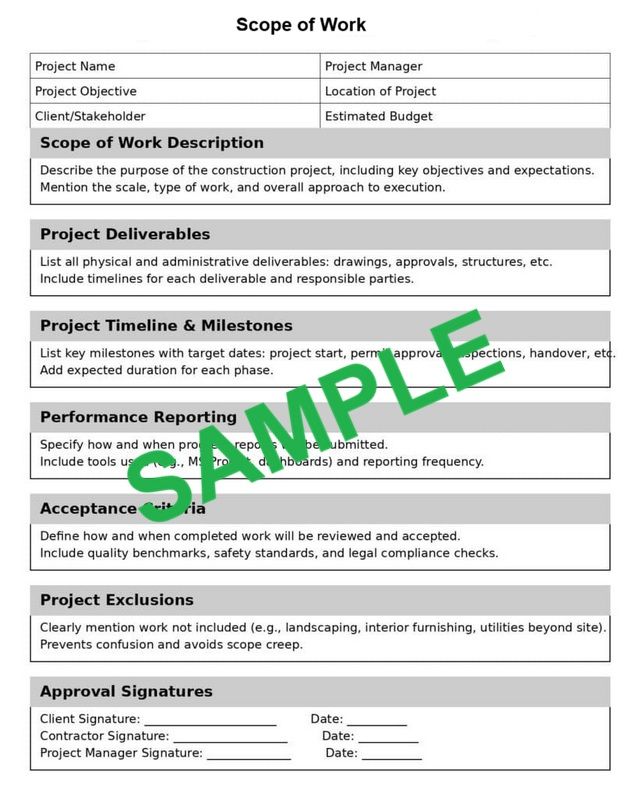
Utilizing a structured project manager scope of work template is essential for consistency and thoroughness. The following sample illustrates the typical sections and level of detail you would expect to find in a comprehensive SOW document. It provides a clear framework that can be adapted for various project types. This template helps ensure all critical aspects are covered.
Project Manager Scope of Work Template: [Project Name]

1. Project Title:
   [e.g., Development of New E-commerce Platform]

2. Project Manager:
   [Name of Project Manager]

3. Client/Sponsor:
   [Name of Client/Sponsor & Organization]

4. Date:
   [Date of Document Creation/Revision]

5. Introduction/Project Overview:
   A brief summary of the project, its purpose, and what it aims to achieve.
   [e.g., This project aims to design, develop, and deploy a new, user-friendly e-commerce platform for ABC Retail, enhancing customer experience and increasing online sales.]

6. Project Objectives:
   Specific, Measurable, Achievable, Relevant, Time-bound (SMART) objectives.
   - [Objective 1: Increase online sales by 25% within 12 months post-launch.]
   - [Objective 2: Improve website load time to under 3 seconds.]
   - [Objective 3: Reduce customer support inquiries related to online ordering by 15%.]

7. Project Deliverables:
   Specific outputs or results to be produced.
   - [Deliverable 1: Detailed functional requirements document.]
   - [Deliverable 2: Fully designed and responsive user interface (UI) mockups.]
   - [Deliverable 3: Deployed e-commerce platform with integrated payment gateway.]
   - [Deliverable 4: Comprehensive user training manual.]

8. Scope of Work (In-Scope Activities):
   Detailed description of tasks and activities included in the project.
   - [Phase 1: Discovery & Planning - requirements gathering, system architecture design.]
   - [Phase 2: Design & Development - UI/UX design, front-end and back-end coding.]
   - [Phase 3: Testing & Quality Assurance - unit, integration, and user acceptance testing.]
   - [Phase 4: Deployment & Launch - platform migration, go-live.]
   - [Phase 5: Post-Launch Support - 30 days of critical bug fixes.]

9. Out-of-Scope Exclusions:
   What is explicitly NOT included in the project.
   - [Creation of marketing content (text, images, videos) for product listings.]
   - [Integration with third-party inventory management systems beyond initial API setup.]
   - [Ongoing maintenance and feature enhancements beyond the initial 30-day support period.]

10. Project Milestones & Timeline:
    Key checkpoints and target dates.
    - [Milestone 1: Requirements Approval - [Date]]
    - [Milestone 2: UI/UX Design Approval - [Date]]
    - [Milestone 3: Platform Development Complete - [Date]]
    - [Milestone 4: User Acceptance Testing (UAT) Complete - [Date]]
    - [Milestone 5: Production Launch - [Date]]

11. Stakeholders and Roles:
    Key individuals involved and their responsibilities.
    - [Project Sponsor: [Name] - Final budget approval, strategic direction.]
    - [Client Product Owner: [Name] - Prioritizing features, UAT sign-off.]
    - [Development Team Lead: [Name] - Technical implementation, code quality.]

12. Assumptions:
    Factors believed to be true for planning purposes.
    - [Client will provide all necessary product data and content by [Date].]
    - [Third-party API integrations will function as documented without significant issues.]
    - [All required software licenses will be procured by the client.]

13. Constraints:
    Limitations affecting the project.
    - [Maximum Project Budget: [Amount]]
    - [Fixed Launch Date: [Date]]
    - [Limited internal IT resources for infrastructure support.]

14. Acceptance Criteria:
    How deliverables will be verified and approved.
    - [All features must pass UAT as per defined test cases.]
    - [Platform must achieve a 'B' or higher on Google PageSpeed Insights.]
    - [All critical bugs must be resolved before launch.]

15. Change Management Process:
    Procedure for handling scope changes.
    - [All change requests must be submitted in writing to the Project Manager.]
    - [Requests will be reviewed by the Project Manager and Project Sponsor within 3 business days.]
    - [Approved changes will result in an updated SOW and revised timeline/budget.]

16. Sign-offs:
    Formal approval by key stakeholders.

    ___________________________             ___________________________
    Client/Sponsor Signature & Date         Project Manager Signature & Date
Implementing this type of project manager scope of work template not only streamlines the project initiation phase but also fosters greater accountability. It ensures everyone involved has a clear reference for what needs to be done, by whom, and by when. A well-defined SOW is a cornerstone of effective project management, reducing the likelihood of project failure.
The importance of a well-defined project manager scope of work template cannot be overstated. It serves as a living document that guides the entire project journey, minimizing risks and maximizing the chances of success. By thoroughly outlining objectives, deliverables, roles, and constraints, project teams can maintain focus and deliver results that truly meet stakeholder expectations.
Adopting a standardized approach with a robust project manager scope of work template empowers project managers to establish clear boundaries, communicate effectively, and manage changes proactively. This ultimately leads to more efficient execution, improved client satisfaction, and a higher success rate for projects of all sizes. Start implementing a detailed SOW today to bring greater clarity and control to your project endeavors.