Embarking on a new project, venture, or strategic initiative is often exciting, yet it carries inherent risks. Many promising ideas falter not because of a lack of ambition, but due to insufficient foundational planning and assessment. This is precisely where a robust feasibility study becomes indispensable, acting as a critical roadmap for informed decision-making. A well-structured feasibility study scope of work template is your foundational tool to ensure every aspect of your proposed project is thoroughly evaluated before significant resources are committed.
Understanding the viability of an idea before diving in headfirst can save enormous amounts of time, money, and effort. A feasibility study systematically explores the practicalities of a proposed project, identifying potential challenges and opportunities. Without a clear framework for this assessment, key areas might be overlooked, leading to costly surprises down the line.
This article will delve into the critical role of a feasibility study, highlight the essential components of its scope of work, and provide a practical template to guide your efforts. You will learn how to define clear objectives, outline methodologies, and articulate deliverables, ensuring your project begins on the strongest possible footing.
Understanding the Core of a Feasibility Study
Before diving into the specifics of a template, it’s vital to grasp what a feasibility study truly entails. It’s a comprehensive analysis that determines if a proposed project is technically, economically, legally, operationally, and schedule-wise achievable. Essentially, it answers the fundamental question: "Can this project be done, and should it be done?"
Defining Feasibility
A feasibility study is a rigorous evaluation of a proposed project’s viability. It systematically assesses whether the project is practical, sustainable, and capable of achieving its intended outcomes. This crucial step helps stakeholders make informed decisions, preventing resources from being allocated to unworkable ventures.
The primary goal is to identify potential problems and opportunities early in the project lifecycle. By uncovering risks and limitations upfront, organizations can mitigate them, refine their project plans, or even decide to abandon an unfeasible idea. This proactive approach significantly reduces financial losses and wasted effort.
The Role of a Scope of Work in Feasibility
A Scope of Work (SOW) document for a feasibility study is a formal agreement that clearly defines the boundaries, tasks, deliverables, and timelines of the study itself. It acts as a contract between the requesting party and the team conducting the feasibility assessment. This clarity is paramount for successful project execution.
The SOW ensures that all stakeholders have a shared understanding of what the feasibility study will cover and what it will produce. It prevents "scope creep," where the study’s objectives expand beyond the initial agreement, leading to delays and increased costs. A well-defined SOW streamlines the entire evaluation process.
Key Components of a Robust Feasibility Study Scope of Work
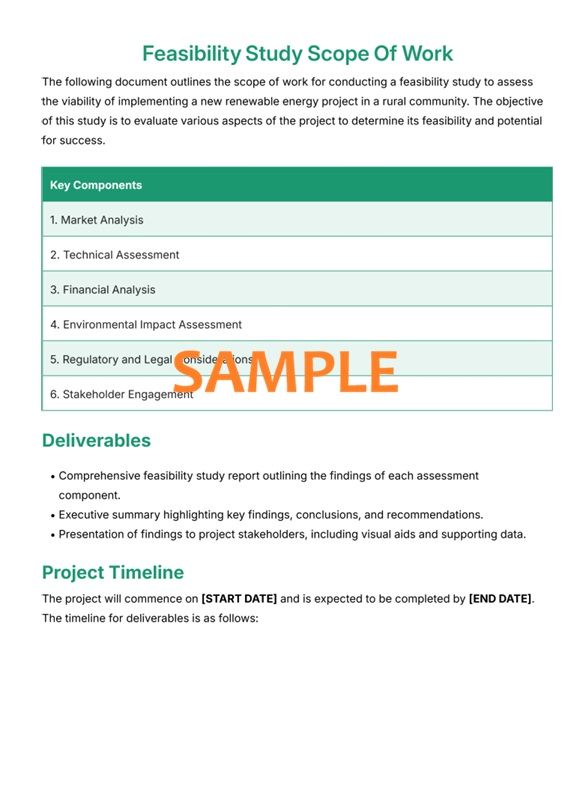
Creating an effective SOW for a feasibility study requires careful consideration of many elements. Each section plays a vital role in setting expectations and guiding the assessment process. A comprehensive feasibility study scope of work template will include specific areas to ensure thoroughness.
Essential Sections to Include
To ensure your feasibility study is comprehensive and well-directed, your SOW should cover several key areas. These sections provide a structured approach, leaving no stone unturned in the evaluation process. Consider these elements carefully when developing your own project.
- Project Background and Objectives: Clearly state the project being considered and the specific questions the feasibility study aims to answer. What problem is the project trying to solve?
- Scope Definition (Inclusions & Exclusions): Precisely define what aspects will be analyzed within the study and, equally important, what will not be. For example, will a market study include international markets or only domestic?
- Methodology: Detail the approach the study team will take. This includes data collection methods (surveys, interviews, market research), analytical tools, and assessment frameworks (e.g., SWOT analysis, financial modeling).
- Deliverables: List all tangible outputs expected from the feasibility study. This typically includes a comprehensive feasibility report, financial projections, risk assessments, and specific recommendations.
- Timeline and Milestones: Outline the key phases of the study, estimated start and end dates, and significant milestones. This helps manage expectations and track progress effectively.
- Resource Requirements: Specify the personnel, expertise, tools, software, and any budgetary considerations needed to conduct the study. This ensures the study team has the necessary support.
- Assumptions and Constraints: Document any underlying assumptions made during the planning of the study, as well as any limitations or constraints that might impact the study’s scope or findings (e.g., access to data, budget limits).
- Risk Assessment (for the study itself): Identify potential risks that could affect the feasibility study’s execution, such as data unavailability or stakeholder non-cooperation, and propose mitigation strategies.
Maximizing the Value of Your SOW
Beyond simply listing components, how you craft and utilize your feasibility study SOW can significantly enhance its impact. It’s not just a checklist but a dynamic document designed to foster understanding and collaboration. Thoughtful planning can make a big difference.
Ensure that the language used is clear, concise, and unambiguous. Ambiguity can lead to misunderstandings and disputes later on. Use plain language and avoid excessive jargon where possible, making it accessible to all stakeholders regardless of their technical background. Regular communication and feedback loops throughout the study are also crucial.
Sample Feasibility Study Scope of Work Template
Below is a simplified feasibility study scope of work template designed to illustrate the typical structure and content. This example focuses on assessing the viability of launching a new mobile application. Remember, a real SOW would contain much more detail under each section.
Project Title: Feasibility Study for “EcoTrack” Mobile Application Launch
1. Introduction and Background:
This Scope of Work outlines the objectives, methodology, and deliverables for a feasibility study concerning the development and launch of “EcoTrack,” a mobile application designed to help users track and reduce their carbon footprint. The study will assess the technical, market, financial, and operational viability of this proposed app.
2. Project Objectives:
The primary objective is to determine the overall feasibility of launching the EcoTrack mobile application within the next 12-18 months. Specific objectives include:
- To assess the market demand and competitive landscape for sustainability-focused mobile applications.
- To evaluate the technical requirements and challenges associated with developing the app.
- To project the financial viability, including development costs, potential revenue streams, and profitability.
- To identify key operational requirements for app launch and ongoing maintenance.
3. Scope Definition:
Inclusions:
- Comprehensive market research on target demographics and competitor analysis.
- Technical assessment of required features, platform compatibility (iOS/Android), and third-party integrations.
- Detailed financial modeling, including cost analysis and revenue projections over three years.
- Analysis of legal and regulatory compliance for data privacy and environmental claims.
- Identification of potential partnerships and marketing strategies.
Exclusions:
- Full-scale app prototyping or development.
- Detailed legal contracts or intellectual property filings.
- Implementation of marketing campaigns.
4. Methodology:
The study will employ a mixed-methods approach, including:
- Primary Research: Online surveys with potential users, interviews with industry experts and sustainability influencers.
- Secondary Research: Analysis of existing market reports, competitor apps, technology trends, and demographic data.
- Financial Analysis: Development of financial models using conservative and aggressive projections, break-even analysis.
- Technical Assessment: Consultation with mobile app developers and platform architects.
5. Deliverables:
- Detailed Feasibility Study Report (approx. 50-70 pages)
- Market Analysis Report (including SWOT analysis and competitive positioning)
- Technical Requirements Document (high-level overview)
- 3-Year Financial Projections (including P&L, Cash Flow, Balance Sheet)
- Risk Assessment and Mitigation Strategies
- Recommendations for Go/No-Go Decision
- Executive Summary Presentation
6. Timeline and Milestones:
- Phase 1: Project Kick-off & Research Plan Finalization (Weeks 1-2)
- Phase 2: Data Collection & Market Analysis (Weeks 3-6)
- Phase 3: Technical & Financial Assessment (Weeks 7-10)
- Phase 4: Report Compilation & Review (Weeks 11-12)
- Phase 5: Final Presentation & Recommendations (Week 13)
7. Resource Requirements:
The study will require a dedicated project lead, a market research analyst, and a financial analyst. Access to specific market intelligence databases and mobile app development consultants will also be necessary. A budget for survey tools and expert consultation fees will be allocated.
8. Assumptions and Constraints:
Assumptions:
- Availability of reliable market data for sustainability applications.
- Cooperation from internal stakeholders for information gathering.
- Access to expert consultants within the specified timeframe.
Constraints:
- Study completion within a 13-week timeframe.
- Budgetary limits for external research tools and expert consultations.
- Focus on the US market only for initial launch feasibility.
A thoroughly crafted feasibility study is not merely a bureaucratic step; it’s a strategic imperative that underpins successful project delivery. By utilizing a robust scope of work, organizations gain clarity, mitigate risks, and ensure alignment across all stakeholders. This methodical approach transforms uncertainty into actionable intelligence, paving the way for confident and informed decision-making.
Embracing the structured guidance of a detailed feasibility study scope of work template empowers your team to conduct a comprehensive assessment. It ensures that every critical facet of a proposed project is examined, from market demand to financial projections and technical viability. Investing in this foundational planning ultimately increases the likelihood of your projects not only launching but thriving.