Embarking on any construction or renovation project, especially one involving drywall, demands absolute clarity from start to finish. Without a precise roadmap, even seemingly straightforward tasks can quickly spiral into costly delays and misunderstandings. This is precisely why a well-crafted drywall scope of work template isn’t just a convenience; it’s a critical tool for success.
A comprehensive scope of work (SOW) document defines every aspect of a project, from materials to timelines and responsibilities. For drywall work, this means outlining installation, finishing, and quality expectations in detail. Learning how to effectively utilize such a template will save you time, money, and potential headaches, ensuring everyone involved is on the same page.
This article will delve into the core components of an effective drywall SOW, explain its benefits, and provide a clear sample. By the end, you’ll understand how to leverage a robust drywall scope of work template to achieve seamless project execution and superior results.
The Essential Elements of a Robust Drywall Scope of Work
A well-structured drywall scope of work serves as the foundational agreement between contractors and clients. It eliminates ambiguity, setting clear expectations for every stage of the drywall installation and finishing process. Defining these elements upfront is crucial for preventing disputes and ensuring a smooth project flow.
Defining Project Objectives and Deliverables
The first step in any successful drywall project is to clearly articulate what needs to be achieved. This section of your drywall scope of work template should precisely state the project’s overall goal. Is it a new construction, a renovation, or a repair job?
Beyond the primary objective, detail the specific deliverables. This includes the total square footage of drywall to be installed, the level of finish required (e.g., Level 3, Level 4, or Level 5), and any special considerations like moisture-resistant drywall for bathrooms or sound-deadening drywall for specific rooms. Clearly outlining these outputs ensures that both parties agree on the final product.
Detailing Materials, Methods, and Timeline
Precision in materials and methods prevents substitution issues and ensures quality. Your drywall scope of work template should specify the exact types of drywall sheets (e.g., 1/2″ standard, 5/8″ fire-rated), joint compound, tape, and fasteners to be used. Include any special requirements for corner beads or archways.
Outline the installation methods, such as hanging orientation, fastener spacing, and number of coats for finishing. A realistic project timeline, including start and completion dates, key milestones for hanging, taping, and sanding, is also vital. This timeline acts as a shared schedule, keeping the project on track and managing expectations around project duration.
Clarifying Responsibilities and Exclusions
To avoid “scope creep” and finger-pointing, clearly delineate who is responsible for what. The drywall scope of work template should specify the contractor’s duties, such as material procurement, installation, finishing, and site cleanup related to their work. Conversely, it must outline client responsibilities, like providing access, ensuring utilities are available, or moving furniture.
Equally important are the explicit exclusions. This might include painting, priming, demolition of existing structures, electrical work, or framing adjustments. Clearly stating what is NOT part of the agreement protects both parties and helps manage project costs effectively. For instance, approximately 30% of construction disputes arise from undefined responsibilities, highlighting the need for this clarity.
Streamlining Your Drywall Projects with a Clear Template
Implementing a standardized drywall scope of work template can transform how you manage your projects. It introduces efficiency, reduces risks, and fosters better communication, leading to more predictable outcomes and higher satisfaction rates. Embracing such a tool is a strategic advantage for any contractor or project manager.
Avoiding Misunderstandings and Disputes
One of the primary benefits of a detailed drywall scope of work template is its ability to prevent costly misunderstandings. When every detail, from the type of drywall to the finishing level, is documented and agreed upon, there’s little room for misinterpretation. This clarity minimizes change orders and costly rework.
A robust SOW acts as a legal reference point, protecting both the contractor and the client should disagreements arise. It provides a written record of what was promised and what was expected, significantly reducing the likelihood of disputes. Clear communication, facilitated by the template, has been shown to decrease project conflicts by up to 25%.
Enhancing Project Efficiency and Budget Control
A well-defined scope leads directly to improved project efficiency. With a clear understanding of tasks, materials, and timelines, project managers can allocate resources more effectively and schedule work with greater precision. This systematic approach reduces wasted time and materials.
Furthermore, a detailed drywall scope of work template is invaluable for accurate budget control. By specifying every item, from labor hours to material costs, contractors can provide precise estimates and clients can anticipate exact expenditures. This transparency helps in avoiding budget overruns, which impact nearly 70% of construction projects according to recent industry analyses.
Ensuring Quality and Client Satisfaction
Quality assurance begins with clear expectations. When the level of drywall finish (e.g., Level 4 for paint, Level 5 for high-gloss finishes) is explicitly stated in the scope of work, both parties have a benchmark for quality. This clarity empowers contractors to deliver to spec and allows clients to verify that the work meets the agreed standards.
Ultimately, delivering a project that aligns perfectly with the initial agreement leads to higher client satisfaction. Clients appreciate transparency and a project completed on time and within budget, reflecting the agreed-upon quality. A comprehensive drywall scope of work template is the cornerstone of building strong client relationships and securing future referrals.
Sample Drywall Scope of Work Template
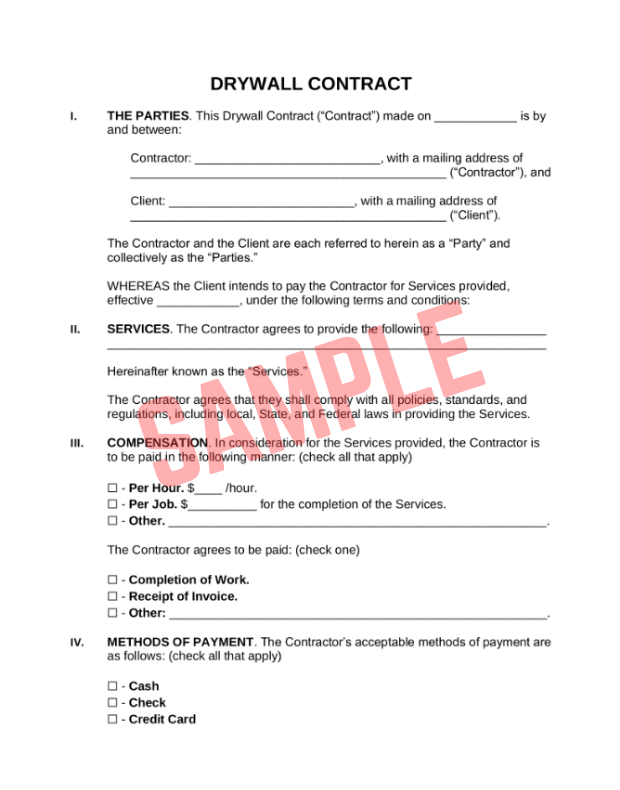
Below is an example of a streamlined drywall scope of work template. This structure provides a clear framework, which you can customize for specific projects. It’s designed to be comprehensive yet easy to understand, ensuring all critical aspects of the drywall job are covered.
Project Overview
- Project Name: [Client Name] Residential Drywall Installation
- Project Location: [Street Address, City, State, Zip Code]
- Project Manager: [Contractor’s Project Manager Name]
- Client Contact: [Client’s Name and Contact Information]
- Proposed Start Date: [MM/DD/YYYY]
- Proposed Completion Date: [MM/DD/YYYY]
Scope of Work – Drywall Installation and Finishing
- Demolition (If Applicable):
- Removal of existing drywall, approximately [X] sq ft.
- Hauling away of demolition debris.
- Note: Removal of insulation, electrical, or plumbing components is excluded.
- Material Specifications:
- Drywall Sheets: [X]” standard gypsum board, [Y]” moisture-resistant gypsum board (for bathrooms/kitchens).
- Fasteners: Drywall screws, appropriate length for framing.
- Joint Compound: Lightweight all-purpose joint compound.
- Joint Tape: Paper tape for flat seams, metal/paper-faced tape for corners.
- Corner Beads: Metal/PVC corner beads for all external corners.
- Drywall Installation (Hanging):
- Installation of new drywall sheets on walls and ceilings as per plans.
- Cutting and fitting drywall around penetrations (outlets, switches, vents).
- Securing drywall with appropriate fasteners and spacing as per industry standards.
- Drywall Finishing (Taping and Mudding):
- Application of joint tape and first coat of joint compound to all seams and internal/external corners.
- Application of second coat of joint compound over taped seams and fastener heads.
- Application of third/final coat of joint compound, feathered out for smooth transitions.
- Sanding of all finished surfaces to achieve a [Level 3/4/5] finish, suitable for paint.
- Cleanup:
- Removal of all drywall scraps, dust, and project-related debris from the work area.
- Broom-clean condition upon completion of drywall work.
Exclusions
- Painting, priming, or applying any final finishes.
- Installation or adjustment of framing, electrical, plumbing, or HVAC systems.
- Relocation or protection of furniture and personal belongings (client’s responsibility).
- Insulation installation (unless specifically added as an additional service).
- Texturing of drywall surfaces (unless specifically added as an additional service).
Payment Schedule
- [X]% down payment upon signing of agreement.
- [Y]% upon completion of drywall hanging.
- [Z]% upon completion of drywall finishing and final inspection.
Signatures
__________________________
Contractor Signature & Date
__________________________
Client Signature & Date
This sample drywall scope of work template provides a solid foundation. Remember to tailor each section to the unique requirements and challenges of your specific project, ensuring every detail is captured for maximum clarity.
Utilizing a comprehensive drywall scope of work template is a game-changer for any construction or renovation project. It lays a clear foundation, ensuring that all parties involved have a shared understanding of what needs to be done, how it will be accomplished, and what the final outcome will be. This level of detail minimizes potential pitfalls, leading to smoother operations and greater overall success. By consistently employing such a template, you’ll not only enhance communication and efficiency but also build a reputation for professionalism and reliability. Embrace the power of a well-defined scope to elevate your drywall projects, satisfy your clients, and secure your standing in the competitive construction industry. Start using one today to transform your project management process.