Establishing clear boundaries and expectations is paramount in any successful business partnership, especially between an advertising agency and its clients. Without a precise roadmap, projects can drift, leading to frustration, budget overruns, and missed deadlines. This is where an effective advertising agency scope of work template becomes an indispensable tool for clarity and mutual understanding.
A well-defined scope of work (SOW) acts as the foundational contract for marketing services, detailing every aspect of a project from start to finish. It ensures that both the agency and the client are perfectly aligned on objectives, deliverables, timelines, and costs. Understanding how to construct and utilize such a template can significantly enhance project efficiency and client satisfaction, paving the way for long-term successful collaborations.
This article will explore the critical components of a robust advertising agency scope of work template. We will delve into why clear documentation is essential, outline the key elements your template should include, and provide a practical sample to guide your agency in developing its own. By the end, you’ll have a comprehensive understanding of how to leverage a SOW for optimal project outcomes.
Why a Clear Scope of Work is Crucial for Marketing Agencies
A well-defined scope of work is more than just a formality; it’s a strategic asset for any advertising agency. It provides a shared document that guides the entire project lifecycle, minimizing ambiguity and maximizing accountability for all parties involved. Investing time in crafting a thorough SOW template upfront can prevent numerous headaches down the line.
Preventing Scope Creep and Misunderstandings
Scope creep is a common challenge in agency-client relationships, often leading to unbilled work and strained budgets. A clear advertising agency scope of work template explicitly defines what is included in the project and, just as importantly, what is not. This written agreement serves as a reference point to manage client expectations and justify additional charges for new requests that fall outside the initial agreement.
By detailing specific deliverables and activities, the SOW prevents assumptions and clarifies boundaries. It ensures both parties have a documented understanding of the project’s parameters. This clarity saves time and resources, allowing the agency to focus on agreed-upon tasks without constant negotiation or dispute.
Setting Realistic Expectations and Deliverables
Clients often have ambitious visions, and agencies must translate these into tangible, achievable outcomes. An effective scope of work template helps to bridge this gap by outlining precise deliverables and project milestones. It clearly articulates what the client will receive, when they will receive it, and the quality standards associated with those deliverables.
This documentation fosters trust by ensuring transparency about the agency’s commitments. It details the services to be rendered, such as campaign strategy, content creation, media buying, or performance reporting. When expectations are set realistically from the outset, the likelihood of client satisfaction upon project completion significantly increases.
Enhancing Client-Agency Communication
The scope of work template serves as a vital communication tool throughout the project. It provides a common language and reference point for discussions, progress updates, and decision-making. Both the agency and the client can refer back to the document to confirm details or resolve any potential disagreements.
Having a documented SOW reduces the reliance on verbal agreements, which can easily be forgotten or misremembered. This formal structure helps maintain a professional relationship and ensures that all project-related communications are grounded in an agreed-upon framework. Effective communication, supported by a clear SOW, is the cornerstone of successful agency-client partnerships.
Essential Elements of an Effective Advertising Agency Scope of Work Template
Creating a comprehensive advertising agency scope of work template requires careful consideration of all project facets. Each section contributes to the overall clarity and success of the client engagement. A robust template ensures no critical detail is overlooked, fostering a smooth workflow and successful project delivery.
Project Overview and Objectives
This section sets the stage for the entire project. It should concisely describe the client’s business, the specific marketing challenge or opportunity, and the overarching goals the advertising campaign aims to achieve. Clearly articulated objectives provide a benchmark against which the project’s success can be measured.
For instance, objectives might include increasing brand awareness by 20%, generating 500 new leads, or improving conversion rates by 15%. This clarity ensures both agency and client are aligned on the ultimate purpose of the work. It establishes the “why” behind every task and deliverable.
Detailed Services and Deliverables
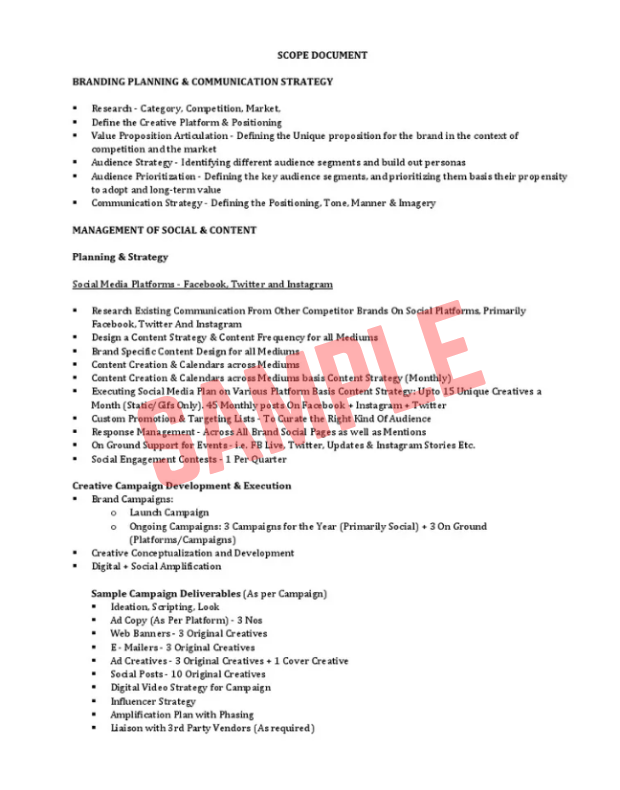
This is the core of the advertising agency scope of work template, outlining the specific tasks and items the agency will provide. It breaks down the broader service into granular deliverables. For example, if “Social Media Management” is a service, deliverables might include “30 custom social media posts per month,” “weekly engagement monitoring,” or “monthly performance reports.”
It’s crucial to be as specific as possible here. List every asset, report, campaign element, or consultation that will be provided. Specify the platforms, formats, and quantities where applicable. This prevents ambiguity about what the client will receive and what the agency is responsible for producing.
Timelines, Milestones, and Reporting
Effective project management relies heavily on clear timelines. This section details the project start and end dates, key milestones, and deadlines for specific deliverables. It can be presented as a simple list or a more detailed phased approach. Including client approval deadlines for stages is also vital to keep the project on track.
Outline the frequency and format of progress reporting. Will there be weekly check-ins, bi-weekly status reports, or monthly performance reviews? Defining these communication points ensures continuous transparency. This structured approach helps manage expectations around project velocity and completion.
Budget, Payment Terms, and Out-of-Pocket Expenses
Financial transparency is non-negotiable. This section clearly states the total project budget, breaking it down by phase or service if applicable. It also outlines the payment schedule, such as an upfront deposit, milestone payments, or monthly retainers. Specify accepted payment methods and invoice due dates.
Additionally, address any potential out-of-pocket expenses, such as media spend, stock photography licenses, third-party software subscriptions, or travel costs. Define how these will be billed and if there’s a cap on such expenses without prior client approval. This financial clarity prevents unexpected costs and ensures smooth billing processes.
Roles, Responsibilities, and Approvals
To avoid confusion, clearly define who is responsible for what. Identify key contacts from both the agency and client sides. Outline the client’s responsibilities, such as providing necessary assets, approvals, or feedback within specified timeframes. This ensures the client understands their role in facilitating project progress.
Establish a clear approval process. Who needs to approve deliverables? What is the turnaround time for approvals? Will approvals be written (e.g., via email or project management tool)? Documenting this avoids bottlenecks and ensures decisions are made efficiently, keeping the project moving forward.
Key Performance Indicators (KPIs) and Success Metrics
How will success be measured? This crucial section aligns the project’s outcomes with tangible metrics. Based on the objectives outlined earlier, identify specific KPIs that will track progress and evaluate the campaign’s effectiveness. Examples include website traffic, conversion rates, social media engagement, click-through rates, or return on ad spend (ROAS).
Defining these metrics upfront ensures both parties agree on what constitutes a successful outcome. It provides a clear framework for post-campaign analysis and helps demonstrate the value delivered by the agency. This data-driven approach solidifies the partnership and showcases the agency’s impact.
Sample Advertising Agency Scope of Work Template
Crafting an effective advertising agency scope of work template involves structuring all critical information clearly and concisely. This sample provides a framework you can adapt to suit various marketing projects, ensuring all key elements are covered. Remember to fill in specific details relevant to your client and their campaign.
[Your Agency Logo]
Advertising Agency Scope of Work
Project Title: [Client Company Name] – [Campaign Name/Project Type]
Version: 1.0 Date: October 26, 2023
Client Company: [Client Company Name] Client Contact: [Client Contact Person, Title, Email, Phone]
Agency: [Your Agency Name] Agency Contact: [Agency Contact Person, Title, Email, Phone]
1. Executive Summary This Scope of Work outlines the strategic marketing partnership between [Your Agency Name] and [Client Company Name] for the [Campaign Name/Project Type] project. The primary goal is to [state primary objective, e.g., increase brand awareness, drive lead generation, enhance online sales]. This document details the services, deliverables, timelines, budget, and responsibilities for the engagement.
2. Project Objectives The specific objectives for this project are:
- [Objective 1: e.g., Increase website organic traffic by 25% within 6 months.]
- [Objective 2: e.g., Generate 100 qualified leads per month through paid social media campaigns.]
- [Objective 3: e.g., Improve brand engagement on Instagram by 30% over 3 months.]
- [Objective 4: e.g., Launch a new product awareness campaign targeting X demographic.]
3. Scope of Services & Deliverables
Phase 1: Strategy & Planning (Weeks 1-2)
- Services:
- Discovery workshop with client stakeholders.
- Market research and competitor analysis.
- Target audience persona development.
- Campaign strategy formulation and presentation.
- Deliverables:
- Detailed Marketing Strategy Document (PDF).
- Audience Persona Profiles (2-3).
- Media Plan Recommendation.
Phase 2: Content Creation & Asset Development (Weeks 3-6)
- Services:
- Copywriting for ad campaigns and landing pages.
- Graphic design for social media ads and display banners.
- Video concepting and scriptwriting (if applicable).
- Deliverables:
- [Number] x Social Media Ad Copy Variations.
- [Number] x Display Ad Banners (various sizes).
- [Number] x Landing Page Copy Versions.
- [Number] x Short-form Video Scripts (e.g., for social reels).
Phase 3: Campaign Implementation & Management (Months 2-6)
- Services:
- Setup and launch of campaigns across agreed platforms (e.g., Google Ads, Facebook/Instagram Ads).
- Daily monitoring and optimization of ad performance.
- A/B testing of ad creative and targeting.
- Bid management and budget allocation adjustments.
- Deliverables:
- Live Ad Campaigns on specified platforms.
- Ongoing campaign optimization reports (internal).
Phase 4: Reporting & Analysis (Ongoing)
- Services:
- Data collection and analysis of campaign performance.
- Development of performance insights and recommendations.
- Deliverables:
- Bi-weekly Performance Reports (PDF/Dashboard access).
- Monthly Review Meeting with client.
- End-of-Campaign Performance Summary.
4. Out-of-Scope Items The following items are explicitly excluded from this Scope of Work:
- Website development or major redesign (minor landing page adjustments are included).
- Search Engine Optimization (SEO) beyond keyword research for paid campaigns.
- Public Relations (PR) activities.
- Influencer marketing campaigns.
5. Project Timelines & Milestones
| Milestone | Due Date | Responsible Party |
|---|---|---|
| Kick-off Meeting | [Date] | Agency, Client |
| Strategy Approval | [Date] | Client |
| Creative Assets Approval | [Date] | Client |
| Campaign Launch | [Date] | Agency |
| Bi-Weekly Reports | Every 2nd Friday | Agency |
| Monthly Performance Reviews | Last Tuesday of Month | Agency, Client |
| Project End Date | [Date] | Agency, Client |
6. Budget & Payment Terms
- Total Project Fee: $[Amount]
- Payment Schedule:
- [X]% upfront deposit upon SOW signing: $[Amount]
- [X]% upon Strategy Approval (Month 1): $[Amount]
- [X]% monthly retainer for [Number] months: $[Amount] per month
- Final [X]% upon Project Completion: $[Amount]
- Out-of-Pocket Expenses:
- Media Spend: Client will pay directly to platforms or reimburse Agency for pre-approved media buys.
- Stock Photography/Video Licenses: Up to $[Amount] included. Beyond this, client approval required.
- Other (e.g., specific software licenses): To be pre-approved by the client.
- Payment Due Date: All invoices are due Net 30 days from the invoice date.
- Late Payment Fee: A [X]% late fee will be applied to overdue invoices.
7. Client Responsibilities To ensure the successful execution of this project, the client agrees to:
- Provide timely feedback and approvals within [Number] business days.
- Supply necessary brand assets (logos, brand guidelines, existing photography/video) by [Date].
- Ensure access to relevant analytics platforms (e.g., Google Analytics, CRM).
- Make key decision-makers available for scheduled meetings.
8. Key Performance Indicators (KPIs) & Success Metrics Success for this project will be primarily measured by:
- Website Traffic: [Specific Metric, e.g., +25% organic sessions, +15% paid sessions]
- Lead Generation: [Specific Metric, e.g., 100 new qualified leads/month, 5% conversion rate]
- Engagement Rate: [Specific Metric, e.g., 5% average engagement on social media]
- Return on Ad Spend (ROAS): [Specific Metric, e.g., 3:1 ROAS for paid campaigns]
9. Signatures
For [Client Company Name]:
[Print Name] [Title] Date:
For [Your Agency Name]:
[Print Name] [Title] Date:
The strategic utilization of an advertising agency scope of work template profoundly impacts the success and profitability of client engagements. By proactively defining project parameters, deliverables, and expectations, agencies can foster stronger client relationships built on trust and transparency. This essential document not only mitigates risks like scope creep but also provides a clear, actionable plan for achieving desired marketing outcomes.
Embracing a standardized, yet adaptable, advertising agency scope of work template is a hallmark of professional project management. It empowers both agencies and clients to approach projects with confidence, ensuring alignment and accountability throughout the entire partnership. Invest in developing a robust SOW template, and watch your agency’s projects run smoother, leading to happier clients and more successful campaigns.